 AASTHA INTERNATIONAL
Industrial Valve Selection Guide for Hazardous Areas: ATEX, IECEx & PESO
Master industrial valve selection for explosive environments. Explore the mechanics of ball, gate, and butterfly valves and navigate ATEX, IECEx, and PESO certification standards.
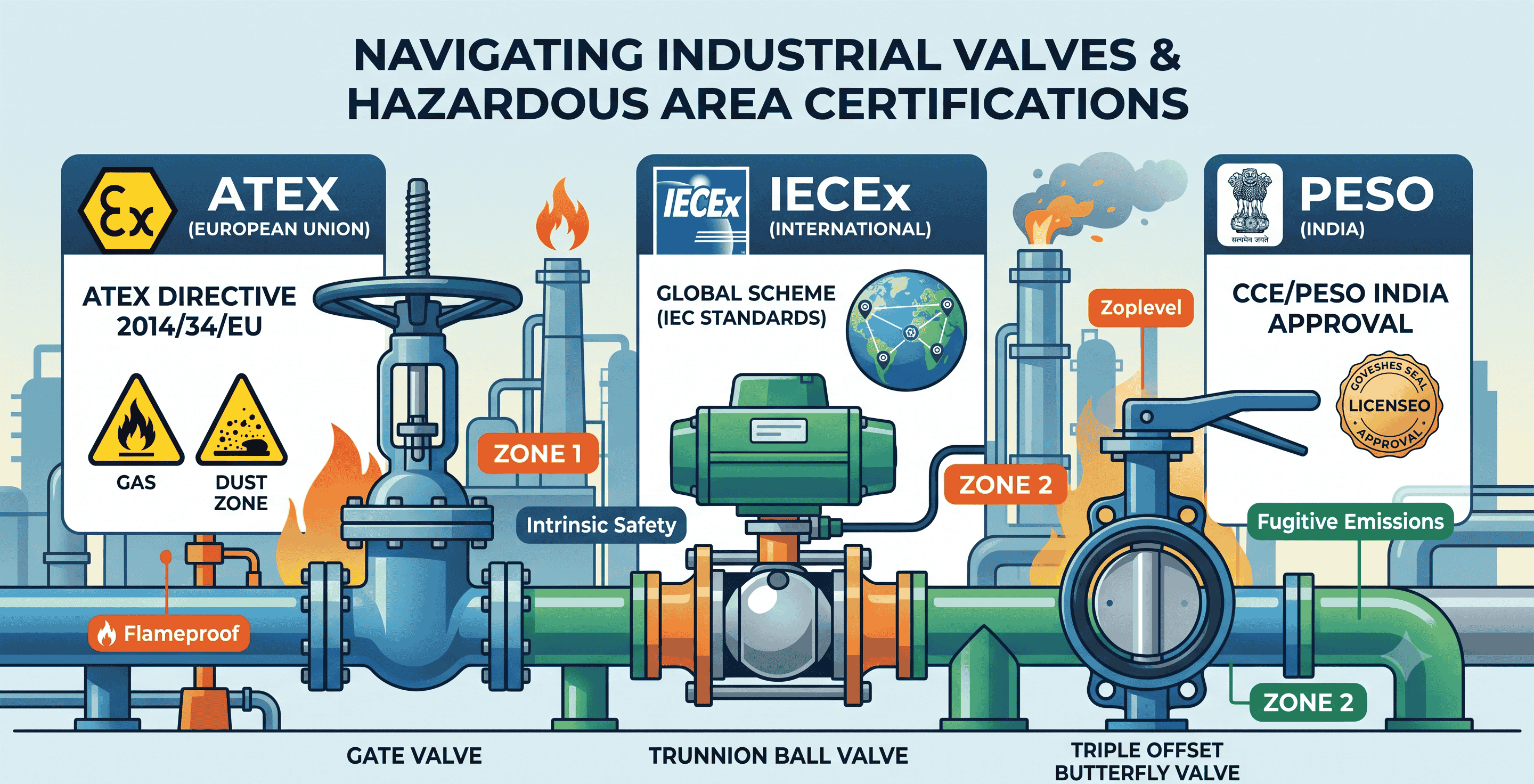
In the high-stakes environments of petrochemical refineries, offshore drilling platforms, and advanced chemical manufacturing facilities, the margin for operational error is non-existent. The presence of flammable gases, volatile vapors, or combustible dust clouds means that a single errant spark, a localized hot spot, or a static discharge can precipitate catastrophic consequences. At the very heart of these complex, high-pressure systems are industrial valves. They serve as the critical gatekeepers of process flow, tasked with holding back explosive media under extreme conditions.
Selecting a valve for a hazardous area is not a simple matter of matching pipe diameters or calculating flow coefficients ($C_v$). It is a rigorous, multi-disciplinary exercise that bridges fluid dynamics, mechanical metallurgy, electrical engineering, and strict international regulatory compliance. When an automated valve assembly—comprising the valve body, actuator, and instrumentation—is installed in a hazardous area, it must meet exact standards to ensure it does not become an ignition source.
This comprehensive guide dissects the intricate mechanics of primary industrial valve types, the unique hazards they present in explosive atmospheres, and the complex web of global certification frameworks—specifically ATEX, IECEx, and PESO—that govern their safe deployment.
The Mechanical Foundation: Core Valve Types and Fluid Dynamics
Before examining the legal and safety frameworks that govern hazardous zones, one must understand the mechanical and functional demands placed on different types of valves. A poorly specified valve will not only degrade process efficiency but can also lead to catastrophic mechanical failure, rendering any electronic safety certifications useless.
Gate Valves: The Heavy-Duty Isolators
Gate valves are the workhorses of industrial isolation. Designed to function like a literal portcullis dropping across the flow path, they are intended strictly for absolute on/off applications.
- Mechanics: A gate valve utilizes a wedge or parallel disc mechanism that lowers into the seat. Because the gate retracts entirely out of the flow path when fully open, gate valves offer virtually zero resistance to the media, resulting in a minimal pressure drop.
- Operational Limitations: They are notoriously slow to actuate. Furthermore, gate valves must never be used to throttle or regulate flow. If left partially open, the high-velocity fluid will cause the gate to vibrate violently, leading to rapid wear of the seating surfaces, wire drawing, and eventual mechanical failure.
- Hazardous Area Considerations: In hazardous zones handling highly flammable liquids, the stem packing of a gate valve is a critical vulnerability. It must be strictly monitored for fugitive emissions (often tested to API 622 or API 624 standards) to prevent volatile organic compounds (VOCs) from leaking into an explosive atmosphere.
Globe Valves: The Masters of Throttling
When a process requires precise flow regulation rather than simple isolation, globe valves are the primary choice.
- Mechanics: These valves feature an internal baffle and an S-shaped flow path. A plug or disc is lowered into a stationary ring seat. The linear motion of the plug allows operators to finely tune fluid movement, making them ideal for flow, temperature, and pressure control loops.
- Fluid Dynamics: Because the fluid must change direction multiple times within the valve body, globe valves introduce a significant pressure drop. In high-pressure liquid applications, this sudden pressure drop can lead to cavitation—the formation and violent collapse of vapor bubbles—which can physically tear away the metal internals of the valve.
- Hazardous Area Considerations: Because globe valves are continuously modulating (moving up and down constantly to adjust flow), the friction on the valve stem is immense. This constant movement can generate static electricity. In Ex-rated zones, the valve must often be equipped with anti-static devices—typically small springs that ground the valve stem to the body, ensuring no static charge can build up and arc.
Ball Valves: The Emergency Responders
Ball valves are incredibly versatile, offering tight shut-off, rapid actuation, and reliable performance across a wide range of pressures and temperatures.
- Mechanics: They utilize a spherical disc with a central bore. A simple quarter-turn ($90^\circ$) of the actuator aligns the bore with the pipeline to allow flow, or sets it perpendicular to block flow entirely.
- Trunnion vs. Floating: For smaller lines and lower pressures, floating ball valves use the pressure of the fluid to push the ball into the downstream seat to create a seal. For high-pressure or large-diameter pipelines, trunnion-mounted ball valves anchor the ball at the top and bottom, using spring-loaded seats to press against the ball. This dramatically reduces the torque required to turn the valve.
- Hazardous Area Considerations: Because they can close in fractions of a second, automated ball valves are ubiquitous in Emergency Shutdown (ESD) and Safety Instrumented Systems (SIS). In explosive environments, ball valves handling flammable liquids must be "Fire Safe" tested (e.g., API 607). This means that if a plant fire melts the primary soft PTFE seats, a secondary metal-to-metal seat will engage to prevent the valve from leaking fuel into the blaze.
Butterfly Valves: The Space-Saving Giants
Butterfly valves are the preferred choice for large-diameter piping where installing a massive gate or ball valve would be prohibitively heavy and expensive.
- Mechanics: A central disc rotates on an axis across the pipe. Like a ball valve, it requires a quarter-turn to fully open or close.
- Advanced Geometries: Standard concentric butterfly valves are suitable for low-pressure utilities. However, in demanding hazardous process applications, Double Offset and Triple Offset designs are required. The triple offset design introduces a conical seating angle that allows the disc to cam into the seat with zero friction, providing metal-to-metal bubble-tight sealing capable of handling extreme temperatures and corrosive chemicals.
- Hazardous Area Considerations: Due to the large surface area of the disc, butterfly valves in hazardous areas must be carefully evaluated for torque requirements. If the process fluid is sticky or contains particulates, the actuator must be sized with a significant safety margin to ensure it can break the valve out of its seated position without drawing excessive electrical current, which could overheat the actuator motor.
Check Valves: The Unsung Protectors
Check valves are purely mechanical, self-actuating valves designed to allow flow in only one direction, automatically preventing dangerous backflow.
- Mechanics: Whether using a swinging flapper, a lifting plug, or dual spring-loaded plates, check valves rely on the kinetic energy of the forward flow to stay open. The moment flow reverses, the valve slams shut.
- Hazardous Area Considerations: In complex chemical processing networks, backflow can cause highly reactive chemicals to mix improperly, potentially initiating an exothermic reaction or an explosion within the pipeline. Selecting "non-slam" check valves is vital to prevent water hammer—a pressure surge that can rupture pipelines and release explosive media into the atmosphere.
The Anatomy of an Explosion: How Valves Become Ignition Sources
In a hazardous industrial environment, the simple presence of flammable gas or dust is not enough to cause an explosion. Three elements must be present simultaneously: a fuel (gas, vapor, or dust), an oxidizer (oxygen in the air), and an ignition source. This is known as the Ignition Triangle.
While the valve body itself is a passive mechanical component, its operation and automation introduce several potential ignition sources:
- Mechanical Sparks: If internal components fail, or if a valve is forced closed against debris, metal-on-metal impact can generate incendiary sparks.
- Static Electricity: As non-conductive fluids rush through a valve body, or as a PTFE-coated valve stem constantly rubs against its packing, static charges accumulate. If the valve is not properly grounded to the pipeline, this static can discharge as a high-voltage spark.
- Thermal Hot Spots: Friction from high-speed throttling, or simply heat transfer from the process media itself, can elevate the surface temperature of the valve or actuator. If the external surface temperature exceeds the Auto-Ignition Temperature (AIT) of the surrounding explosive atmosphere, the air itself will combust without a spark.
- Electrical Arcing: The most common danger comes from the automation equipment. Solenoid valves, electric actuators, limit switches, and positioners all utilize electrical currents. Normal operation, a short circuit, or a relay switching can produce a tiny arc capable of igniting the surrounding air.
To neutralize these ignition sources, global regulatory bodies have developed strict legal frameworks and engineering standards.
Deciphering the Regulatory Shield: ATEX, IECEx, and PESO
To operate legally and safely, equipment placed in hazardous locations must undergo rigorous third-party testing and certification. The three most prominent frameworks encountered in global engineering are ATEX, IECEx, and PESO. While they share the exact same physical engineering principles—often testing to the exact same IEC 60079 series of standards—their legal applications and geographical scopes differ dramatically.
1. ATEX (The European Union Mandate)
"ATEX" is an acronym derived from the French Appareils destinés à être utilisés en ATmosphères EXplosibles. It is not just an engineering standard; it is legally binding European Union legislation.
The Directives:
ATEX is split into two primary directives. The ATEX Workplace Directive (1999/92/EC) dictates the obligations of the employer to protect workers, requiring plant managers to classify their facilities into distinct hazardous Zones. The ATEX Equipment Directive (2014/34/EU) governs the manufacturers, dictating the design, testing, and certification required to sell equipment meant to operate in those Zones.
Zone Classification:
ATEX requires plant operators to categorize their environment based on the frequency and duration of an explosive atmosphere:
- Zone 0 (Gas) / Zone 20 (Dust): An explosive atmosphere is present continuously, for long periods, or frequently. (e.g., inside a fuel storage tank).
- Zone 1 (Gas) / Zone 21 (Dust): An explosive atmosphere is likely to occur in normal operation occasionally. (e.g., near pump seals or sampling points).
- Zone 2 (Gas) / Zone 22 (Dust): An explosive atmosphere is not likely to occur in normal operation but, if it does occur, will persist for a short period only. (e.g., general piping areas).
Equipment Categories:
Manufacturers must then build valves and actuators that map to these zones:
- Category 1 equipment offers very high protection, featuring two independent means of protection. If one safety mechanism fails, the second takes over. It is required for Zone 0.
- Category 2 equipment offers high protection, suitable for Zone 1.
- Category 3 equipment offers normal protection, suitable for Zone 2.
Because ATEX is a legal directive within the European Economic Area (EEA), compliance is demonstrated via the CE mark, the distinctive hexagonal 'Ex' logo, and a Declaration of Conformity. A critical quirk of ATEX is that for Category 3 (Zone 2) equipment, manufacturers can often self-certify their products without third-party laboratory testing.
2. IECEx (The International Standard)
The IECEx system (International Electrotechnical Commission System for Certification to Standards Relating to Equipment for Use in Explosive Atmospheres) was born out of a desire for global standardization.
Unlike ATEX, IECEx is not driven by the legislation of a single government; it is a voluntary international certification scheme. Its goal is "one test, one certificate, accepted everywhere."
ATEX vs. IECEx:
While a valve actuator might be tested to the exact same technical standard (like IEC 60079-1 for flameproof enclosures) for both ATEX and IECEx, the administrative process is different.
- No Self-Certification: IECEx strictly prohibits manufacturer self-declaration. Even for the lowest-risk Zone 2 equipment, an independent, IECEx-approved certification body (ExCB) must test the product.
- Quality Audits: IECEx requires ongoing, strict surveillance of the manufacturer’s quality management system (QAR - Quality Assessment Report).
- The Certificate of Conformity (CoC): IECEx issues a unified electronic CoC that is publicly searchable in a global database, ensuring complete transparency and making it nearly impossible to forge a certificate.
For international mega-projects spanning multiple continents—such as a Floating Production Storage and Offloading (FPSO) vessel built in South Korea, owned by a Norwegian company, and operating off the coast of Brazil—IECEx is the preferred specification because it transcends regional politics and offers a universally understood baseline of safety.
3. PESO (The Indian Regulatory Landscape)
When engineering projects extend into the Indian subcontinent, international certifications like ATEX and IECEx are no longer sufficient on their own. Enter PESO—the Petroleum and Explosives Safety Organization.
Operating under the Department for Promotion of Industry and Internal Trade (DPIIT), PESO administers the legal framework governing hazardous substances in India, tracing its roots back to the Indian Explosives Act of 1884.
The PESO Approval Process:
PESO is a strict national mandate. It is illegal to import, install, or operate electrical equipment in hazardous areas in India without formal approval from the Chief Controller of Explosives (CCE) under PESO.
Unlike ATEX, which is a standalone testing framework, PESO approval is largely an administrative and vetting process that relies on base testing from international bodies.
- Bridging the Gap: To obtain PESO approval for an automated valve, the manufacturer must typically first possess a valid IECEx or ATEX test report from a recognized international laboratory (like PTB in Germany, Baseefa in the UK, or UL in the USA).
- The India-Specific Nuance: PESO reviewers heavily favor IECEx over ATEX because of the mandatory third-party oversight inherent in the IECEx system. They will scrutinize the international test reports, the manufacturer’s quality systems, and the specific application of the equipment.
- Local Representation: Foreign manufacturers cannot apply for PESO directly; they must appoint a legally recognized Authorized Indian Representative (AIR) to manage the application and take legal responsibility for the equipment's compliance on Indian soil.
If the documentation satisfies the rigorous safety standards of the Indian government, PESO issues an approval certificate, legally authorizing the valve for deployment in India’s booming refining and petrochemical sectors.
The Step-by-Step Guide to Specifying a Valve for a Hazardous Area
When tasked with procuring an automated valve—let’s say, a trunnion-mounted ball valve with an electric actuator for a refinery manifold—an engineer must cross-reference process demands with Ex-certification parameters.
Step 1: Define the Protection Concept (The "Ex" Code)
Once the Zone (0, 1, or 2) is established, you must choose how the actuator will prevent an explosion. The three most common protection concepts for valve automation are:
- Ex d (Flameproof Enclosure): The most traditional method. The actuator’s electronics are housed in a heavy, cast-metal enclosure. It does not prevent explosive gas from entering; rather, if an internal spark ignites the gas inside the housing, the enclosure is built strong enough to contain the physical blast. The joints of the housing are precisely machined to cool the escaping flames to a safe temperature before they reach the outside atmosphere.
- Ex i (Intrinsic Safety): The most elegant method, required for Zone 0. Intrinsic safety uses Zener barriers in the control room to artificially limit the electrical energy (voltage and current) reaching the valve’s positioners or limit switches. Even under fault conditions (like a short circuit), there simply is not enough electrical energy to generate an incendiary spark.
- Ex e (Increased Safety): Often used for junction boxes and solenoid coils. This method ensures no arcs, sparks, or hot surfaces can occur during normal operation by using highly robust insulation, specialized anti-vibration terminals, and high-impact exterior housings.
Step 2: Determine the Gas or Dust Group
Not all hazardous gases require the same energy to ignite. Equipment must be rated for the specific chemical group present:
- Group IIA: Typical gases like Propane. Easiest to contain.
- Group IIB: Gases like Ethylene. Requires tighter tolerances.
- Group IIC: The most volatile gases, including Hydrogen and Acetylene.
Hydrogen is incredibly dangerous because its molecules are exceptionally small and its Minimum Ignition Energy (MIE) is extraordinarily low. If an environment contains Hydrogen, a valve actuator must have an Ex d IIC rating. The machined gaps on an IIC flameproof enclosure must be micro-millimeters tight to prevent hydrogen flames from escaping.
- Note on Dust: Dust environments are categorized under Group III (IIIA for combustible flyings, IIIB for non-conductive dust, IIIC for highly dangerous conductive dust like metal powders).
Step 3: Specify the Temperature Class (T-Class)
The external surface temperature of the valve body (heated by process fluid) and the actuator (heated by its internal motor) must never reach the Auto-Ignition Temperature (AIT) of the surrounding gas.
Certifications utilize a T-Class system:
- T1: Maximum surface temp $450^\circ C$ (Suitable for Methane, AIT $537^\circ C$)
- T2: $300^\circ C$
- T3: $200^\circ C$
- T4: $135^\circ C$
- T5: $100^\circ C$
- T6: $85^\circ C$ (Suitable for Carbon Disulfide, AIT $90^\circ C$)
Specifying a T6 rating offers the highest level of safety, guaranteeing the equipment surface will never exceed $85^\circ C$. However, engineering an electric actuator to run heavy loads without exceeding $85^\circ C$ is mechanically difficult and incredibly expensive. Accurate T-Class specification prevents vast over-engineering costs while ensuring process safety.
Step 4: Integrating SIL (Safety Integrity Level)
In modern automated plants, Ex-certification is heavily intertwined with SIL ratings (IEC 61508 / 61511). While ATEX/IECEx focuses on preventing the valve from causing an explosion, SIL focuses on ensuring the valve actually performs its job when an emergency occurs.
If a reactor is over-pressurizing, the safety system commands a blowdown valve to open. A SIL 3 rating statistically guarantees the valve assembly has an exceedingly low probability of failing on demand. A proper hazardous area specification will state, for example: "Actuated Ball Valve, Ex d IIC T4, IECEx certified, suitable for SIL 3 application."
The intersection of mechanical engineering, thermodynamics, and international law makes valve specification in hazardous areas one of the most critical disciplines in industrial design. Whether a facility operates under the regional legal directives of ATEX in Europe, relies on the standardized transparency of IECEx for global maritime operations, or navigates the specific national mandates of PESO in India, the core objective remains the same. By understanding the distinct fluid dynamics of gate, globe, ball, and butterfly valves, and marrying them to the stringent requirements of intrinsic safety, flameproof enclosures, and temperature classes, engineering teams can build resilient systems that contain extreme pressures while definitively neutralizing the threat of catastrophic ignition.